ADHD and OCD: Understanding the Differences and When They Co-Occur
Attention-Deficit/Hyperactivity Disorder (ADHD) and Obsessive-Compulsive Disorder (OCD) are distinct clinical conditions with different underlying features, but they can occur together. When they co-occur, symptoms may overlap in ways that make it difficult to determine whether a behavior is related to attention and executive functioning, anxiety and compulsive processes, or both.
ADHD and OCD: What’s the Difference?
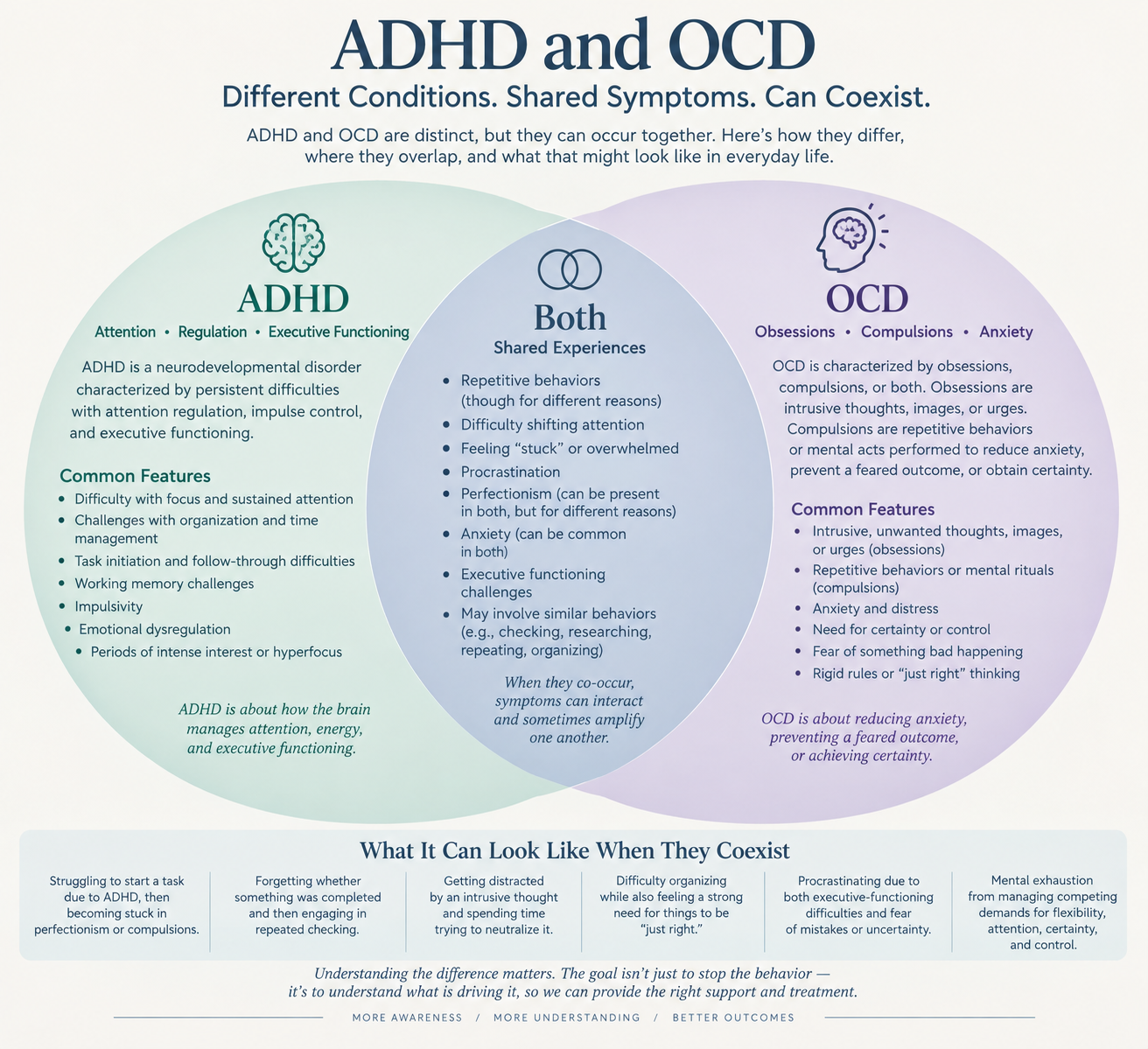
ADHD is a neurodevelopmental disorder characterized by persistent difficulties with attention regulation, impulse control, and executive functioning. Depending on the individual, this may include difficulty with organization, working memory, task initiation, time management, sustained attention, emotional regulation, and inhibition. Individuals with ADHD may also experience periods of intense interest or hyperfocus, particularly when an activity is novel, rewarding, or highly engaging.
OCD is characterized by obsessions, compulsions, or both. Obsessions are recurrent, intrusive thoughts, images, or urges that are experienced as unwanted and distressing. Compulsions are repetitive behaviors or mental acts performed in response to an obsession or according to rigid internal rules, often with the goal of reducing anxiety, preventing a feared outcome, or obtaining a sense of certainty or completion.
Although both conditions can involve repetitive behaviors, difficulty shifting attention, or feeling "stuck," the function of the behavior is often different.
For example, an individual with ADHD may repeatedly check whether they completed a task because they genuinely cannot remember doing it. An individual with OCD may repeatedly check despite remembering that the task was completed because they cannot tolerate the possibility that they may have made a mistake or that something could go wrong.
Similarly, someone with ADHD may avoid a task because it feels boring, overwhelming, or difficult to initiate. Someone with OCD may avoid a task because it triggers intrusive thoughts, uncertainty, fear of making a mistake, or the possibility of experiencing distress.
When ADHD and OCD Occur Together
When ADHD and OCD co-occur, the symptoms can interact and sometimes amplify one another.
An individual might:
Struggle with task initiation due to executive-functioning difficulties and then become stuck in perfectionistic or compulsive processes once the task begins.
Lose track of whether something was completed and subsequently become caught in repeated checking.
Become distracted by an intrusive thought and then spend significant time attempting to analyze, suppress, reassure, or neutralize it.
Have difficulty organizing belongings while simultaneously experiencing an intense need for certain things to feel "just right."
Procrastinate because of both executive-functioning difficulties and anxiety surrounding uncertainty or mistakes.
Hyperfocus on researching a concern in an attempt to reach certainty, while OCD continually generates additional questions or doubts.
Experience significant mental fatigue from attempting to manage competing demands for flexibility, attention, certainty, and control.
This can create a cycle in which ADHD-related difficulties contribute to mistakes, forgetfulness, or disorganization, which then become triggers for OCD-related checking, reassurance seeking, or mental review.
Why Understanding the Difference Matters
Effective treatment begins with understanding what is driving the behavior rather than simply identifying what the behavior looks like.
Not every repetitive behavior is a compulsion, and not every difficulty with concentration is ADHD. Likewise, perfectionism, anxiety, or a strong preference for organization does not automatically indicate OCD.
A thorough clinical assessment considers the individual's developmental history, symptom patterns, internal experience, functional impairment, and the purpose or function of the behavior.
When ADHD and OCD occur together, treatment may need to address both conditions. ADHD interventions may focus on executive functioning, attention regulation, organization, and environmental supports, while evidence-based OCD treatment such as Exposure and Response Prevention (ERP) targets the cycle of obsessions, compulsions, avoidance, and intolerance of uncertainty.
Understanding the distinction can be validating for individuals and families. Instead of asking, "Why can't I just stop doing this?" a more clinically useful question may be:
"What is driving this behavior—and what is my brain trying to accomplish by doing it?"
That distinction can be an important first step toward appropriate assessment, effective treatment, and greater self-understanding.