


Giftedness, Connection, and Mental Health: It’s More Than Being “Smart”
Giftedness is about much more than a high IQ or being “smart.” Understanding the way a gifted brain processes the world can be an important piece of understanding a child’s emotional health, relationships, identity, and overall well-being.
When I get a call from a parent who says, “My child is gifted,” I often follow it with:
“Okay. Let’s see what else is there.”
Not because giftedness isn't important—it absolutely is. But giftedness is about much more than a high IQ or being “smart.” Understanding the way a gifted brain processes the world can be an important piece of understanding a child’s emotional health, relationships, identity, and overall well-being.
Gifted Doesn't Just Mean “Smarter”
Giftedness is often misunderstood as simply being ahead academically or having a higher IQ. In reality, gifted individuals may process information differently, make connections more quickly or deeply, notice patterns others don't, think abstractly at an early age, and spend significant amounts of time thinking about questions that their peers may not even be considering yet.
This can create an interesting paradox:
A child can be highly capable intellectually and still struggle socially, emotionally, or developmentally.
In fact, the very qualities that make someone gifted can sometimes contribute to feelings of being different, misunderstood, or disconnected.
Giftedness is often considered a form of neurodivergence because the brain processes information and experiences the world differently from the majority of the population. That difference deserves to be understood—not minimized because a child is doing well academically.
“If They're So Smart, Why Are They Struggling?”
This is one of the biggest misconceptions surrounding giftedness.
Because gifted children may appear capable, adults can assume they should automatically know how to manage frustration, regulate emotions, navigate relationships, advocate for themselves, or cope with existential questions.
But cognitive ability and emotional development don't necessarily progress at the same rate.
A child may be able to understand complex concepts while still being a child who needs help learning how to manage big feelings.
They may understand the concept of mortality long before their peers are thinking about it. They may question fairness, purpose, morality, existence, or the future at an age when the adults around them aren't expecting those conversations.
And sometimes, what looks like anxiety, avoidance, perfectionism, lack of motivation, or even defiance has another layer underneath it.
That is why when someone tells me their child is gifted, my next question is often:
“What else is going on?”
Giftedness may be part of the explanation—not the entire explanation.
The Loneliness of Thinking Differently
One of the most important pieces of giftedness that often gets overlooked is connection.
Imagine being surrounded by people who are perfectly nice and whom you genuinely like, but still feeling as though something is missing.
You can participate. You can socialize. You can make friends.
But there may be a persistent feeling of:
“They don't quite think the way I do.”
For some profoundly gifted individuals, particularly those with IQs approaching or exceeding 140, the experience of cognitive difference can become more pronounced. The population becomes smaller as cognitive ability increases, which means finding others who naturally process information in a similar way can become more difficult.
This can contribute to loneliness, social disconnection, and a feeling of being “different” that may be difficult to put into words.
I sometimes explain this to clients this way:
You aren't unable to connect. You may simply be looking for the 0.5% of the population who can connect back with you in that particular way.
That distinction matters.
Because when a gifted child repeatedly feels misunderstood, they may eventually conclude that they are the problem.
They may begin masking.
They may stop sharing their interests.
They may make themselves smaller.
They may learn to avoid certain conversations because they have experienced too many blank looks, dismissive responses, or comments like, “You're thinking too much.”
Over time, that can affect identity and attachment.
The Importance of Finding “Your People”
Gifted children need opportunities to connect with other children who understand them—not necessarily children with the exact same IQ, but children who share their curiosity, intensity, interests, humor, creativity, or way of thinking.
This is why intellectual peers matter.
A child can have plenty of friends and still need cognitive connection.
When gifted children have opportunities to experience that connection, something important can happen: they don't have to work quite as hard to explain themselves.
They can simply be.
And for many gifted adults, the same thing remains true.
There is often a kind of radar for connection.
You meet someone and suddenly realize:
“Oh. You think like me.”
The conversation moves differently. The humor lands differently. You don't have to explain every connection your brain just made. You can talk about the big questions without worrying that you've gone “too deep.”
And perhaps most importantly, you can unmask.
When you finally find the person—or people—with whom you can genuinely be seen and understood, you've found a match.
Don't give up looking for that connection.
Giftedness and Mental Health
Giftedness itself is not a mental health disorder, and being gifted does not automatically mean someone will experience mental health difficulties.
However, the experience of being cognitively different can intersect with mental health in meaningful ways.
Some gifted individuals experience heightened intensity, perfectionism, overthinking, existential concerns, or difficulty finding environments that provide enough intellectual stimulation. Others may experience anxiety, depression, burnout, social isolation, or a sense of meaninglessness.
There is also important research examining suicide risk among gifted and highly intelligent populations. The relationship is complex, and giftedness should not be presented as a direct cause of suicide. Mental health risk is influenced by many factors, including depression, trauma, social isolation, family and environmental factors, and access to support.
What is important is that we don't dismiss emotional distress simply because someone is bright.
A child who appears exceptionally capable may still be struggling deeply.
And sometimes, their ability to articulate complex thoughts can actually cause adults to underestimate how much support they need.
Existential Depression
Another concept that can emerge in gifted individuals is existential depression—a sense of distress connected to questions about meaning, purpose, mortality, identity, injustice, or the larger human experience.
A gifted child may ask questions such as:
Why are we here?
What happens when we die?
Why do people hurt each other?
What's the point if everything eventually ends?
Why does the world work this way?
Why can't everyone see what I see?
These aren't necessarily signs that something is wrong.
Sometimes they are signs of a young person trying to make sense of a world they are capable of thinking about on a deeper level than their developmental environment is prepared to support.
That doesn't mean we ignore depression or anxiety when they are present. It means we look at the whole picture.
When Giftedness Follows Us Into Adulthood
Giftedness doesn't disappear when childhood ends.
Adults may continue to struggle with feeling different, under-stimulated, misunderstood, or disconnected. Some become extremely successful. Others experience burnout, career dissatisfaction, perfectionism, procrastination, or what can look like a failure to thrive despite having significant talent and ability.
Sometimes the problem isn't a lack of ability.
It's too much thinking and not enough doing.
The gifted adult may see every possible outcome, identify every potential problem, recognize every way something could go wrong, and think through an idea until the opportunity to act has passed.
Meanwhile, someone with less cognitive complexity may simply say:
“Let's try it.”
And go.
That can be incredibly frustrating for a gifted person who knows they have the ability but can't seem to translate all of that potential into action.
Fear of failure, perfectionism, rejection sensitivity, anxiety, or the pressure to “live up to” one's potential can keep talented people hidden behind their own thoughts.
Understanding Yourself Changes Things
One of the most powerful things we can give a gifted child is an understanding of how their brain works.
Not an identity that says, “You're smarter than everyone else.”
But an understanding that says:
“Your brain works differently, and that difference comes with strengths, challenges, and needs.”
That distinction matters.
Gifted children need challenge without constant pressure. They need intellectual peers. They need adults who can tolerate their questions. They need emotional support that matches their cognitive complexity. They need permission to be curious, intense, creative, weird, deep, funny, passionate, and sometimes completely overwhelmed.
And they need to know that being different does not mean being alone.
Helping Our Bright Stars Find Their Light
As parents, educators, and clinicians, we can't manufacture connection for our children.
But we can help create the conditions where connection is more likely to happen.
We can seek out environments where they meet like-minded peers. We can take their questions seriously. We can help them understand their own brains. We can look beyond the IQ score and ask what else might be happening emotionally, socially, developmentally, and relationally.
And we can remind them that they don't have to dim themselves to belong.
Gifted people are a minority of the population. Sometimes, being one of those bright stars can feel lonely when you're surrounded by people who don't quite understand the way you see the world.
But the goal isn't to make yourself less bright.
It's to find the people who can see the light—and shine alongside you.
And sometimes, our job as parents and clinicians is simply to help those bright stars discover just how brightly they were meant to shine.

Nobody Talks about Emotional Dysphoria in ADHD
For many children with ADHD, the emotional experience can be just as significant as the challenges with attention, organization, or impulse control.
Children with ADHD may experience emotions quickly, intensely, and sometimes with difficulty returning to a regulated state. Perceived criticism, correction, disappointment, exclusion, or rejection can feel particularly painful. The term Rejection Sensitive Dysphoria (RSD) is often used to describe this intense emotional response to perceived or actual rejection, although RSD is not a formal clinical diagnosis.
For many children with ADHD, the emotional experience can be just as significant as the challenges with attention, organization, or impulse control.
Children with ADHD may experience emotions quickly, intensely, and sometimes with difficulty returning to a regulated state. Perceived criticism, correction, disappointment, exclusion, or rejection can feel particularly painful. The term Rejection Sensitive Dysphoria (RSD) is often used to describe this intense emotional response to perceived or actual rejection, although RSD is not a formal clinical diagnosis.
This can create moments that are difficult for both children and parents. A small correction may feel enormous to the child. A child who is told, "That's not what happened," may hear, "I'm bad." A disagreement with a friend may become, "Nobody likes me." A mistake at school may become, "I'm stupid."
Parents can be the anchor.
When a child's emotions are running high, the goal is not to immediately convince them that their feelings are wrong. It is also not to allow the emotion to determine the facts.
Parents can help by becoming the anchor between the child's emotional experience and reality:
"I can see that really hurt."
"It makes sense that you're disappointed."
"Let's slow down and figure out what actually happened."
"Feeling rejected doesn't necessarily mean you were rejected."
"Making a mistake doesn't mean you are a failure."
This process teaches an incredibly important skill: emotions provide information, but they do not always provide the whole story.
Over time, children can begin to recognize the difference between what happened, what they felt, and what their brain told them it meant.
The goal isn't to prevent rejection.
Children will experience disappointment, criticism, conflict, mistakes, and rejection. We cannot—and should not—remove all of these experiences.
Instead, we want to help children develop the ability to experience difficult emotions without allowing those emotions to define their identity.
This is particularly important for children with ADHD because repeated experiences of correction or feeling "different" can sometimes contribute to negative self-beliefs. A child who repeatedly hears that they are careless, too emotional, disruptive, forgetful, or not trying hard enough may eventually internalize those messages.
Parents can instead help separate behavior from identity:
"You made a mistake" is very different from "You are a problem."
"That behavior wasn't okay" is different from "You're bad."
"You need to work on this skill" is different from "Something is wrong with you."
What can rejection sensitivity look like in adults?
Rejection sensitivity does not necessarily disappear when a child becomes an adult. Adults with ADHD may continue to experience intense emotional responses to criticism, perceived rejection, interpersonal conflict, or feelings of failure.
It may look like:
Replaying a conversation for hours after receiving feedback.
Assuming a delayed text response means someone is upset with you.
Becoming defensive before fully hearing what another person is saying.
Avoiding difficult conversations because of anticipated criticism.
People-pleasing to prevent the possibility of disappointing someone.
Withdrawing or shutting down after feeling embarrassed or rejected.
Moving quickly from "They didn't like what I did" to "They don't like me."
Experiencing an intense emotional reaction and later realizing the situation was not as catastrophic as it initially felt.
For adults, the work becomes less about having someone else serve as the anchor and more about learning to become your own anchor.
Building the adult skill of becoming your own anchor
When a strong reaction occurs, try creating a pause between the trigger and the response.
1. Regulate before you interpret.
If you are highly activated, give yourself time before sending the text, responding to feedback, quitting the conversation, or making a major decision. Take a walk, breathe, drink water, or simply give yourself 20 minutes to come back down.
2. Separate the event from the interpretation.
Ask yourself:
What actually happened?
What am I feeling?
What story am I telling myself about what happened?
What evidence supports that story?
What else could be true?
3. Check for all-or-nothing thinking.
Try replacing "They are disappointed in me" with "They are disappointed about something I did." Those statements carry very different meanings.
4. Delay reassurance-seeking.
If your first instinct is to repeatedly ask, "Are you mad at me?" or "Do you still like me?", consider pausing and allowing yourself some uncertainty before seeking reassurance.
5. Ask for clarification instead of assuming rejection.
A simple statement such as, "I noticed your feedback felt difficult for me to hear. Can you clarify what you would like me to do differently?" can turn an emotionally charged moment into a productive conversation.
6. Practice receiving feedback without making it an identity statement.
Feedback about a behavior, decision, or mistake is not necessarily a judgment of your worth. Try asking, "What is the useful information here?"
7. Repair rather than withdraw.
If your emotional response was stronger than you intended, you can return to the conversation: "I was feeling overwhelmed and reacted defensively. I'd like to try that conversation again." Learning to repair is often more important than learning to never become dysregulated.
From external anchor to internal anchor
This is one of the most important developmental shifts parents can support.
A young child may need a parent to say, "You're okay. Let's figure this out together."
An adolescent may begin learning to say, "I know this feels awful right now, but I don't have all the information yet."
An adult can eventually learn to say to themselves:
"This feeling is real. I don't have to act on it immediately. I can slow down, separate the facts from the story, and decide what I want to do next."
That is the goal—not eliminating sensitivity, avoiding rejection, or teaching someone to dismiss their emotions. It is helping them develop enough self-awareness to recognize when their emotional response has become larger than the available information.
With the right support, what begins as an overwhelming emotional experience can become an opportunity to develop self-regulation, perspective-taking, resilience, and healthier relationships.
The long-term goal is not for children to need their parents to regulate every difficult feeling. It is for parents to provide enough safety, language, and guidance that their children eventually learn how to do that for themselves.
ADHD and OCD: Understanding the Differences and When They Co-Occur
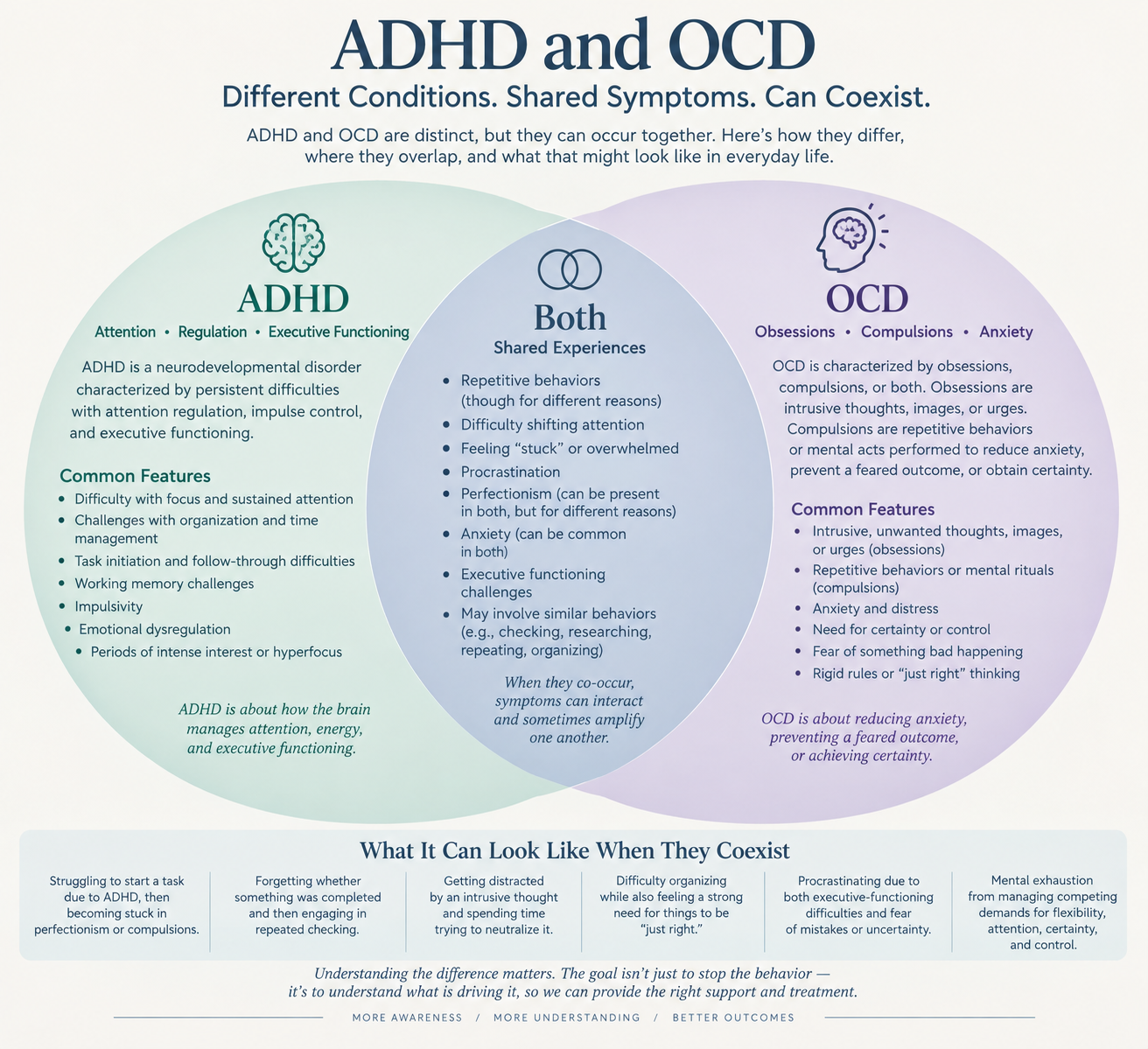
Attention-Deficit/Hyperactivity Disorder (ADHD) and Obsessive-Compulsive Disorder (OCD) are distinct clinical conditions with different underlying features, but they can occur together. When they co-occur, symptoms may overlap in ways that make it difficult to determine whether a behavior is related to attention and executive functioning, anxiety and compulsive processes, or both.
Attention-Deficit/Hyperactivity Disorder (ADHD) and Obsessive-Compulsive Disorder (OCD) are distinct clinical conditions with different underlying features, but they can occur together. When they co-occur, symptoms may overlap in ways that make it difficult to determine whether a behavior is related to attention and executive functioning, anxiety and compulsive processes, or both.
ADHD and OCD: What’s the Difference?
ADHD is a neurodevelopmental disorder characterized by persistent difficulties with attention regulation, impulse control, and executive functioning. Depending on the individual, this may include difficulty with organization, working memory, task initiation, time management, sustained attention, emotional regulation, and inhibition. Individuals with ADHD may also experience periods of intense interest or hyperfocus, particularly when an activity is novel, rewarding, or highly engaging.
OCD is characterized by obsessions, compulsions, or both. Obsessions are recurrent, intrusive thoughts, images, or urges that are experienced as unwanted and distressing. Compulsions are repetitive behaviors or mental acts performed in response to an obsession or according to rigid internal rules, often with the goal of reducing anxiety, preventing a feared outcome, or obtaining a sense of certainty or completion.
Although both conditions can involve repetitive behaviors, difficulty shifting attention, or feeling "stuck," the function of the behavior is often different.
For example, an individual with ADHD may repeatedly check whether they completed a task because they genuinely cannot remember doing it. An individual with OCD may repeatedly check despite remembering that the task was completed because they cannot tolerate the possibility that they may have made a mistake or that something could go wrong.
Similarly, someone with ADHD may avoid a task because it feels boring, overwhelming, or difficult to initiate. Someone with OCD may avoid a task because it triggers intrusive thoughts, uncertainty, fear of making a mistake, or the possibility of experiencing distress.
When ADHD and OCD Occur Together
When ADHD and OCD co-occur, the symptoms can interact and sometimes amplify one another.
An individual might:
Struggle with task initiation due to executive-functioning difficulties and then become stuck in perfectionistic or compulsive processes once the task begins.
Lose track of whether something was completed and subsequently become caught in repeated checking.
Become distracted by an intrusive thought and then spend significant time attempting to analyze, suppress, reassure, or neutralize it.
Have difficulty organizing belongings while simultaneously experiencing an intense need for certain things to feel "just right."
Procrastinate because of both executive-functioning difficulties and anxiety surrounding uncertainty or mistakes.
Hyperfocus on researching a concern in an attempt to reach certainty, while OCD continually generates additional questions or doubts.
Experience significant mental fatigue from attempting to manage competing demands for flexibility, attention, certainty, and control.
This can create a cycle in which ADHD-related difficulties contribute to mistakes, forgetfulness, or disorganization, which then become triggers for OCD-related checking, reassurance seeking, or mental review.
Why Understanding the Difference Matters
Effective treatment begins with understanding what is driving the behavior rather than simply identifying what the behavior looks like.
Not every repetitive behavior is a compulsion, and not every difficulty with concentration is ADHD. Likewise, perfectionism, anxiety, or a strong preference for organization does not automatically indicate OCD.
A thorough clinical assessment considers the individual's developmental history, symptom patterns, internal experience, functional impairment, and the purpose or function of the behavior.
When ADHD and OCD occur together, treatment may need to address both conditions. ADHD interventions may focus on executive functioning, attention regulation, organization, and environmental supports, while evidence-based OCD treatment such as Exposure and Response Prevention (ERP) targets the cycle of obsessions, compulsions, avoidance, and intolerance of uncertainty.
Understanding the distinction can be validating for individuals and families. Instead of asking, "Why can't I just stop doing this?" a more clinically useful question may be:
"What is driving this behavior—and what is my brain trying to accomplish by doing it?"
That distinction can be an important first step toward appropriate assessment, effective treatment, and greater self-understanding.

What Is Twice-Exceptional—and Why Does It Matter?
Twice-exceptional, or 2e, describes someone who is both gifted and has a neurodevelopmental difference such as ADHD, autism, dyslexia, or another learning difference. These two parts of a person can sometimes mask one another, making 2e individuals particularly difficult to recognize and understand.
Twice-exceptional, or 2e, describes someone who is both gifted and has a neurodevelopmental difference such as ADHD, autism, dyslexia, or another learning difference. These two parts of a person can sometimes mask one another, making 2e individuals particularly difficult to recognize and understand.
A child may be exceptionally curious, creative, verbal, analytical, or intellectually advanced while simultaneously struggling with executive functioning, sensory processing, attention, emotional regulation, or traditional classroom expectations. Because their strengths can compensate for their challenges—or their challenges can obscure their strengths—they may be misunderstood as lazy, unmotivated, inconsistent, oppositional, or simply "not living up to their potential."
But giftedness is about much more than having a high IQ.
Gifted individuals may experience the world with greater intensity, complexity, curiosity, sensitivity, or depth. They may make connections quickly, think several steps ahead, question assumptions, notice patterns others miss, or become deeply absorbed in subjects that interest them. Their brains may operate differently from what is expected in a traditional educational or work environment.
This is one reason many people understand giftedness within the broader conversation around neurodiversity. Recognizing giftedness as a different way of processing and experiencing the world—not simply a measure of intelligence—can change how we understand both the strengths and challenges that come with it.
2e Doesn't End When School Ends
One common misconception is that giftedness and 2e are primarily childhood or educational concerns. They aren't.
The 2e child becomes a 2e adult.
Adults may continue to experience the same differences in attention, executive functioning, sensory processing, social connection, emotional intensity, and need for intellectual stimulation. They may have learned to compensate so effectively that no one recognized what was happening underneath the surface.
Some adults describe feeling chronically bored, misunderstood, "too much," or out of step with others. Others may struggle when their work, relationships, or daily lives don't provide enough challenge or meaning.
For some gifted individuals, a lack of intellectual, creative, or emotional enrichment can contribute to profound feelings of emptiness or existential depression—particularly when a person is wrestling with questions about purpose, identity, mortality, injustice, or the meaning of life. This doesn't mean giftedness inherently causes depression. Rather, understanding a person's need for depth, stimulation, meaning, and connection can be an important part of understanding their overall well-being.
Understanding Changes the Question
Instead of asking, "Why can't this person just apply themselves?" we can begin asking:
What kind of environment allows this person to thrive?
Enrichment isn't about pushing gifted children harder or expecting more from them. It can mean giving them opportunities to explore deeply, follow curiosity, create, question, problem-solve, connect with people who think similarly, and develop areas of genuine passion.
And for adults, enrichment might look like continuing education, creative pursuits, meaningful work, intellectual communities, entrepreneurship, hobbies, mentorship, or simply having space to explore the questions that naturally arise from a highly curious mind.
Understanding 2e means seeing the whole person—both their challenges and their remarkable strengths.
Because sometimes what looks like a problem to be fixed is actually a brain that needs to be understood, supported, challenged, and given room to grow.

Navigating the Real World with ADHD: From College to Career with a Fast Brain
The transition from college to career is challenging for most students—but for those with ADHD, it can feel like stepping into chaos without a map. College often provides structure through syllabi, deadlines, and regular feedback, but once you graduate, that scaffolding disappears. Suddenly, you're expected to manage your time, prioritize goals, and make life-defining decisions—all while networking, job-hunting, and staying productive in environments that often aren’t designed for neurodivergent minds.
The transition from college to career is challenging for most students—but for those with ADHD, it can feel like stepping into chaos without a map. College often provides structure through syllabi, deadlines, and regular feedback, but once you graduate, that scaffolding disappears. Suddenly, you're expected to manage your time, prioritize goals, and make life-defining decisions—all while networking, job-hunting, and staying productive in environments that often aren’t designed for neurodivergent minds.
ADHD isn’t just about distraction. It’s about executive dysfunction, cognitive overwhelm, and an often misunderstood experience of the world. These challenges can make the leap from structured academia to the ambiguous "real world" particularly daunting.
Executive Dysfunction and the Job Hunt
Executive function is the brain's management system. It helps you plan, prioritize, start tasks, stay focused, regulate emotions, and shift between ideas. In ADHD, these systems are often impaired. This means that even when someone with ADHD has brilliant ideas, they may struggle to execute them.
Take the job search, for example. It requires sustained effort over time, attention to detail, and a proactive mindset—qualities that can clash with ADHD-related struggles like task initiation, organization, and focus. A student might sit down to apply for jobs, only to get sidetracked for hours researching unrelated things or tweaking their résumé endlessly without ever clicking “submit.” The result? Paralysis, guilt, and missed opportunities.
Cognitive Overwhelm in a High-Stimulus World
Modern adult life is full of demands—emails, applications, appointments, bills, social expectations—and for people with ADHD, this constant input can cause cognitive overload. With an ADHD brain, everything can feel equally urgent and important. The inability to prioritize leads to mental exhaustion and emotional burnout.
This overwhelm isn’t just inconvenient; it’s disabling. A college grad might have huge potential, creativity, and ambition, but feel crushed under the weight of “simple” tasks like scheduling a doctor’s appointment or remembering to follow up after an interview.
Stress Management: A Hidden Battle
People with ADHD experience emotional dysregulation more intensely than their neurotypical peers. Rejection sensitivity, anxiety, and the internalized shame of "not measuring up" can make every misstep feel catastrophic. That emotional weight can trigger a stress response that worsens ADHD symptoms, creating a vicious cycle.
Stress also interferes with sleep, decision-making, and energy levels—factors crucial to navigating a new career or adult responsibilities. A stressful environment with no coping strategies can turn a promising opportunity into a source of dread.
Support Systems: No One Succeeds Alone
The first step toward thriving post-college with ADHD is rejecting the myth of self-sufficiency. Everyone needs support—but for neurodivergent individuals, it’s essential. Whether it’s a coach, therapist, mentor, or even a friend who acts as an accountability buddy, external structure helps replace the internal systems that may be inconsistent.
Many college students lose access to disability accommodations or campus resources after graduation. It’s critical to seek out or build a new support network early—consider therapy with a clinician trained in ADHD, career coaches who understand neurodiversity, or joining online communities where others share strategies and encouragement.
Creating a Real-World Plan for a Fast Brain
The ADHD brain is often filled with big ideas, creativity, and energy—but without a system, those ideas can remain trapped in the clouds. Here’s how to create a path forward:
Break Down Goals: Translate big visions into small, actionable steps. If your goal is to land a marketing job, your first steps might be updating your LinkedIn, drafting a résumé, and emailing a professor for a reference.
Use Visual Planning Tools: Kanban boards, color-coded calendars, and mind maps help ADHD brains see the big picture without losing the details. Tools like Trello, Notion, or even sticky notes on a wall can make abstract plans feel tangible.
Build Routines: Habits reduce decision fatigue. Start with small daily anchors—like a morning walk, a set time to check emails, or a Sunday night planning session. These rituals create rhythm and reduce chaos.
Prioritize Self-Compassion: You won’t do everything perfectly. You’ll forget things, miss deadlines, and feel overwhelmed. That’s okay. Success with ADHD is about persistence, not perfection.
Celebrate Progress: ADHD brains thrive on dopamine, which means acknowledging even small wins matters. Send the application? That’s a win. Ask for help? Huge win.
ADHD isn’t a limitation—it’s a different operating system. And while transitioning from college to the real world may feel like upgrading to a more complex game without a tutorial, it’s possible to succeed by creating your own rules, tools, and support. With the right strategies and a mindset focused on progress over perfection, young adults with ADHD can transform their fast brains and big ideas into powerful careers and fulfilling lives.
ADHD and the Cerebellum: The Missing Piece
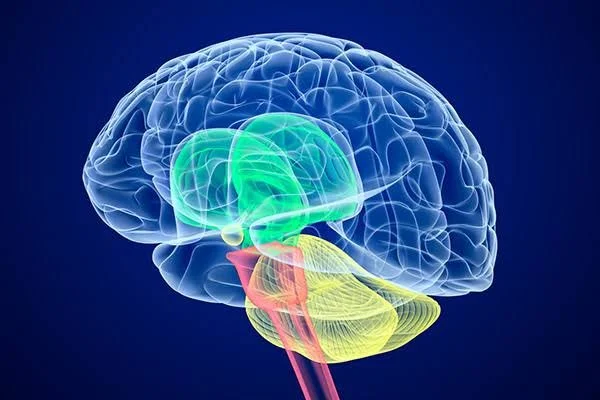
Located at the back of the brain, the cerebellum has traditionally been associated with coordination, balance, and motor control. For decades, it was viewed primarily as a regulator of physical movement. But neuroscience has evolved. We now understand that the cerebellum is deeply involved in cognitive and emotional processes, including attention, timing, executive functioning, and emotional regulation—all areas commonly affected in ADHD.
Most conversations about ADHD center on the prefrontal cortex—the part of the brain responsible for planning, attention, and impulse control. It’s often framed as the brain’s “CEO,” and in ADHD, that CEO can struggle to manage competing demands. While this perspective is important, it’s also incomplete.
There’s another structure that plays a critical—yet often overlooked—role in ADHD: the cerebellum.
Located at the back of the brain, the cerebellum has traditionally been associated with coordination, balance, and motor control. For decades, it was viewed primarily as a regulator of physical movement. But neuroscience has evolved. We now understand that the cerebellum is deeply involved in cognitive and emotional processes, including attention, timing, executive functioning, and emotional regulation—all areas commonly affected in ADHD.
Research suggests that in individuals with ADHD, the cerebellum may function differently or show reduced connectivity with other brain regions, particularly the prefrontal cortex. When communication between these regions is less efficient, the brain can struggle to integrate information smoothly, regulate attention, and modulate emotional responses.
In real life, this goes far beyond “trouble focusing.” It can feel like being out of sync—starting tasks too late or too early, losing track of time, struggling with transitions, or experiencing emotional reactions that feel sudden and difficult to control. For many individuals with ADHD, there is not just a cognitive challenge, but a physical sense of restlessness or internal tension that accompanies it.
Medication is often a first-line treatment for ADHD, and for good reason. Stimulant and non- stimulant medications can improve neural communication and help regulate attention and behavior. For many, they provide meaningful relief and increase the capacity to function in daily life.
But medication is only one piece of the puzzle.
Understanding the cerebellum opens the door to additional, often underutilized, ways of supporting ADHD. Unlike the prefrontal cortex, which responds well to structured cognitive strategies, the cerebellum thrives on movement, rhythm, coordination, and repetition. It is closely tied to the nervous system, meaning that when it is dysregulated, the body often feels it first— through restlessness, tension, or a persistent sense of being “on edge.”
This connection helps explain why many individuals with ADHD report feeling more focused or calm when they are physically engaged. Whether it’s walking, dancing, playing sports, or even fidgeting, these experiences are not just behavioral—they are neurological.
Activities that involve coordination, balance, and timing directly engage the cerebellum and help strengthen its connections with other parts of the brain. Over time, this can support more efficient communication between brain regions and improve overall self-regulation.
Rhythm, in particular, plays a powerful role. Listening to music, playing an instrument, or moving at a steady pace provides predictable sensory input that the brain can organize and anticipate. This predictability can have a stabilizing effect, helping to regulate both attention and emotion. It’s one reason music can feel simultaneously calming and energizing.
Similarly, activities that challenge balance and coordination—such as yoga, biking, swimming, or even using a balance board—require continuous adjustments that are largely governed by the cerebellum. These adjustments help fine-tune the brain’s ability to process and respond to incoming information. In this way, movement becomes more than exercise; it becomes a form of brain-based support.
These activities may also support the brain’s reward system. ADHD is often associated with differences in dopamine regulation, which can make it harder to stay motivated, especially for tasks that feel repetitive or unstimulating. Movement and rhythm-based activities tend to provide immediate feedback and a sense of progress, which can naturally enhance engagement and motivation.
Importantly, this doesn’t mean there is a one-size-fits-all approach. The most effective activities are often the ones that feel enjoyable and intrinsically motivating. For one person, that might be drumming or dancing. For another, it could be taking short movement breaks throughout the day, going for a bike ride, or practicing yoga. Small, consistent doses of coordinated movement can make a meaningful difference over time.
These strategies are not meant to replace traditional treatments, but to complement them. Therapy can support emotional awareness and coping skills. Medication can improve baseline functioning. Movement and rhythm-based activities can strengthen regulation and integration. Together, they create a more flexible and comprehensive approach to managing ADHD.
Reframing ADHD through the lens of the cerebellum also invites a broader shift in perspective. Rather than viewing ADHD solely as a deficit in attention or self-control, it may be more accurate to understand it as a difference in how the brain processes, integrates, and regulates information—both cognitively and physically.
Supporting ADHD, then, is not about forcing the brain to function a certain way. It’s about expanding the range of tools available for focus, regulation, and well-being.
And sometimes, the most effective tools are the ones that engage both the brain and the body— where movement, rhythm, and curiosity come together to create lasting change.